AUG PRAG Violin Anno 1796 Bohemian Prag(ue) School
$9,800.00


Branded:
ANO. 1796
Bohemia is a former kingdom, situated within the Czech Republic. If Germany had won World War II, Bohemia would indeed be in southern Germany (i.e., the Sudetenland). Bohemia today is bounded by Austria in the southeast, by Germany in the west and northwest, by Poland in the north and northeast, and by Moravia in the east. Many German-speaking violin makers lived in Bohemia, but so did Czech-speaking makers. The French word “Bohemién” originally referred to the Gypsies/Roma migrating from Bohemia or generally the Eastern direction towards France and was later adopted for all people living a non-conformist lifestyle.
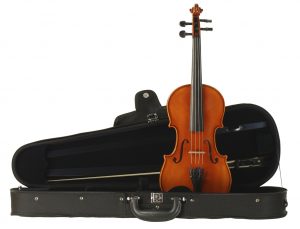
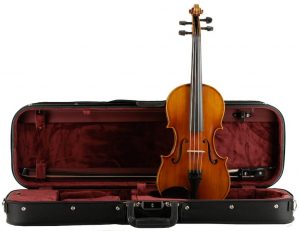
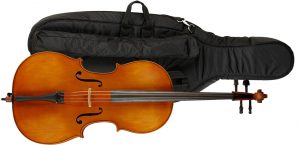
This violin was made in Bohemia around 1790-1800. It has been repaired and had varnish work over the years. The cheeks have been reinforced, the scroll has been grafted, I think twice, the fingerboard, nut, and saddle have been replaced here at the shop. We have cut a new bridge, soundpost, completed bushing in all eight holes, and cut a new set of pegs. The violin still retains the original maple/ebony purfling so close to the perimeter outline of the violin, the spruce corner blocks, and the shallow linings of willow inside the bones of the violin. The original maple scroll with tons of evidence of handwork with its short volute, is one of the violin’s most interesting features. I love the scroll, it’s so different than what is considered the norm today. It’s a Wow! The f holes are caricatures – overdone, sweeping, arresting, and not symmetrical as the bass side f hole is almost 1.0 mm. longer than the treble side. This violin is made of a spruce table, one-piece, also unique. The back is two-piece figured maple, the ribs, also mildly figured maple, and a grafted maple neck terminating in a pegbox and scroll of plain maple. The instrument is hand varnish in an amber- brown laid over a yellow ground – a gamboge with a delicate film of real patina wear. The patina is real, and the wear is real. The general arch of the plates is typical Bohemian craftsmanship around the early 1800’s, built with precise care by fine craftsman. No electric tool touched the violin and no bright light at a bench ever saw the outline of the instrument, inside or out. The top plate is very fine grain spruce typical of this period using very old growth, slow growing veined wood, another Wow! The two-piece back is subtle flame maple. The instrument has one restored crack on the treble side lower bout down to the bottom of the violin. This split has been restored and cleated. The violin is free of any soundpost, bass bar cracks, or wing splits, which is awesome and rare, a valuable feature for an instrument of this age. Great care went into in making the instrument and it is worthy of a maker’s name. The violin is branded and has markings, but I cannot be sure of the exact maker, just a school and region of makers.
Corpus 355.0 mm., Major Width 193.0 mm., Minor Width 161.0 mm., Rib Height 29.0 mm.
This violin drives and performs like a finely engineered car. Smooth sound but the player needs to know when to give it more gas. The violin speaks well, responsive even in higher positions. The instrument has a rich and woody character to the sound that a good player will discover that I found with a lighter bow. The violin is not a powerhouse, not an instrument to be used by a soloist with a large orchestra. There is plenty of sound, but more refined; it is highly expressive and will give a player both sides of the dynamic range when called on. I love the lush, mature bottom and the lighter crisp sound of the treble side. The treble side is more brilliant than the bass side, clean and willing to give much more sound than I really needed. The violin would be a great instrument for sure, in quartet playing or small ensemble. The sound is noble, slightly sophisticated, and clean. I love the sound and have already decided to play this violin at our Christmas Eve services for church in two weeks.