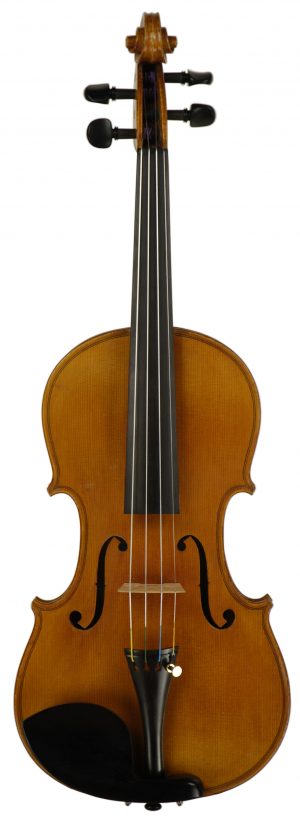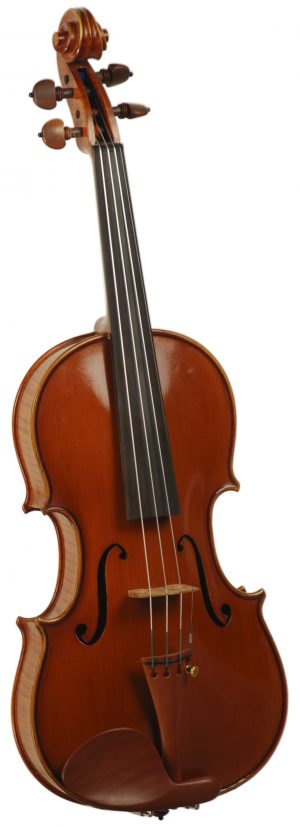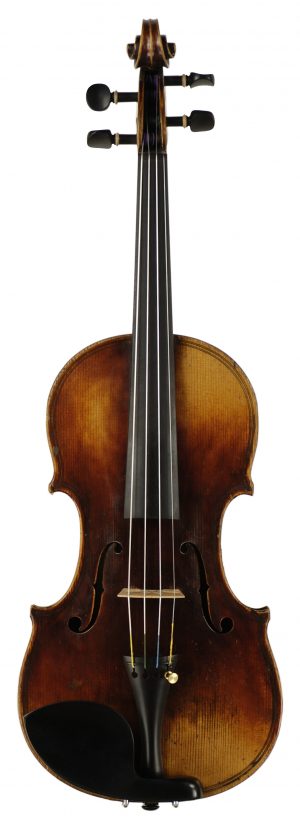
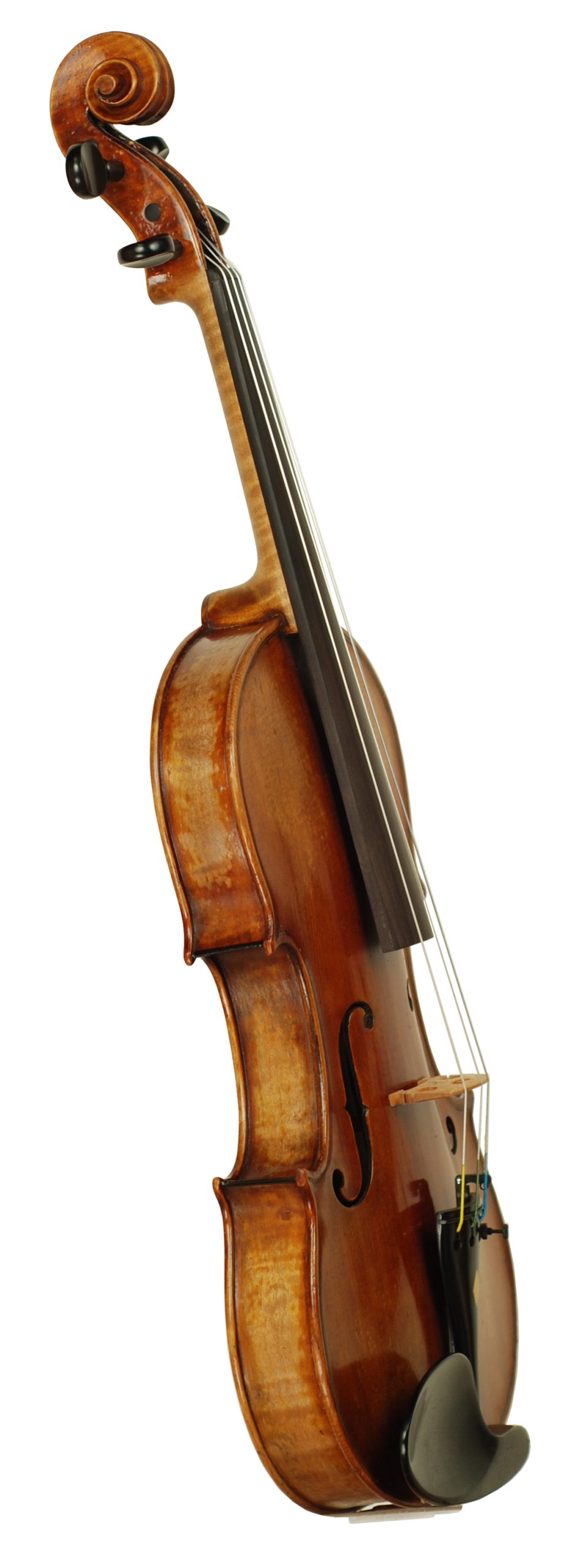
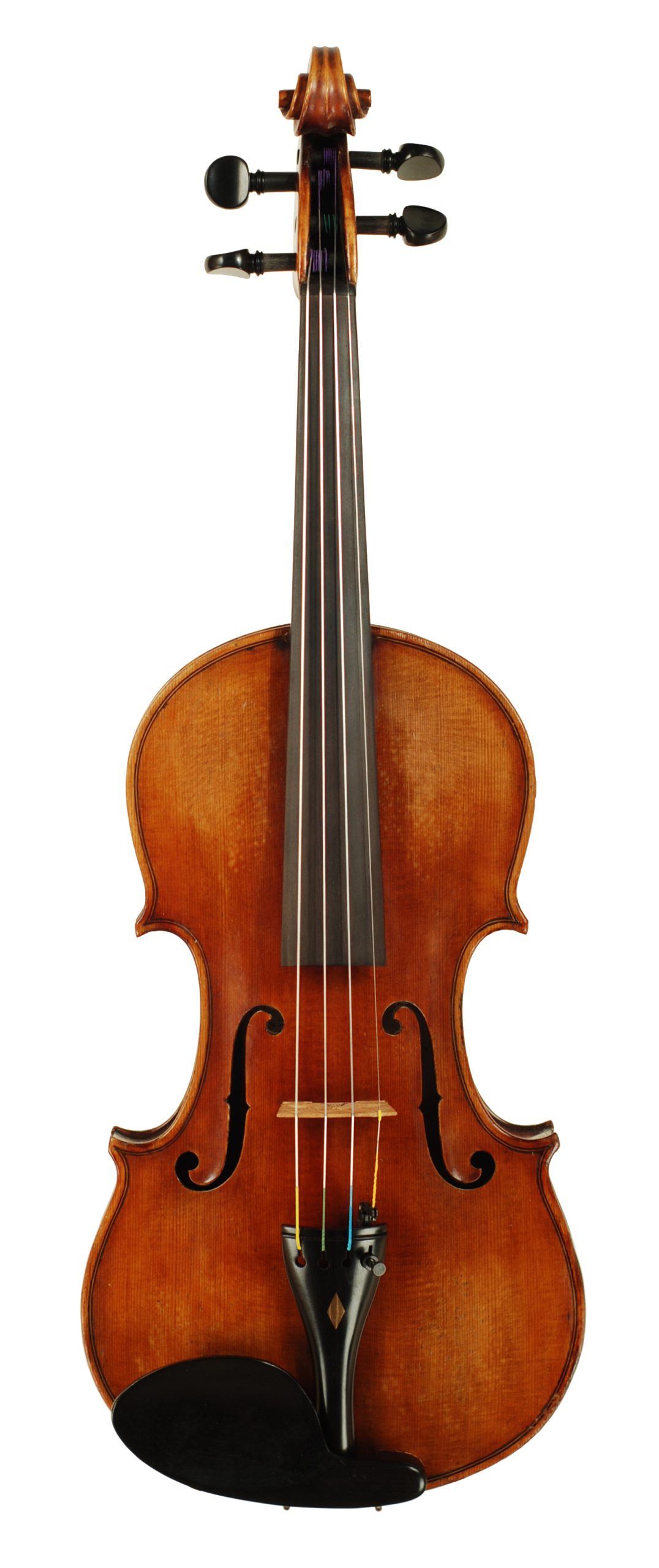
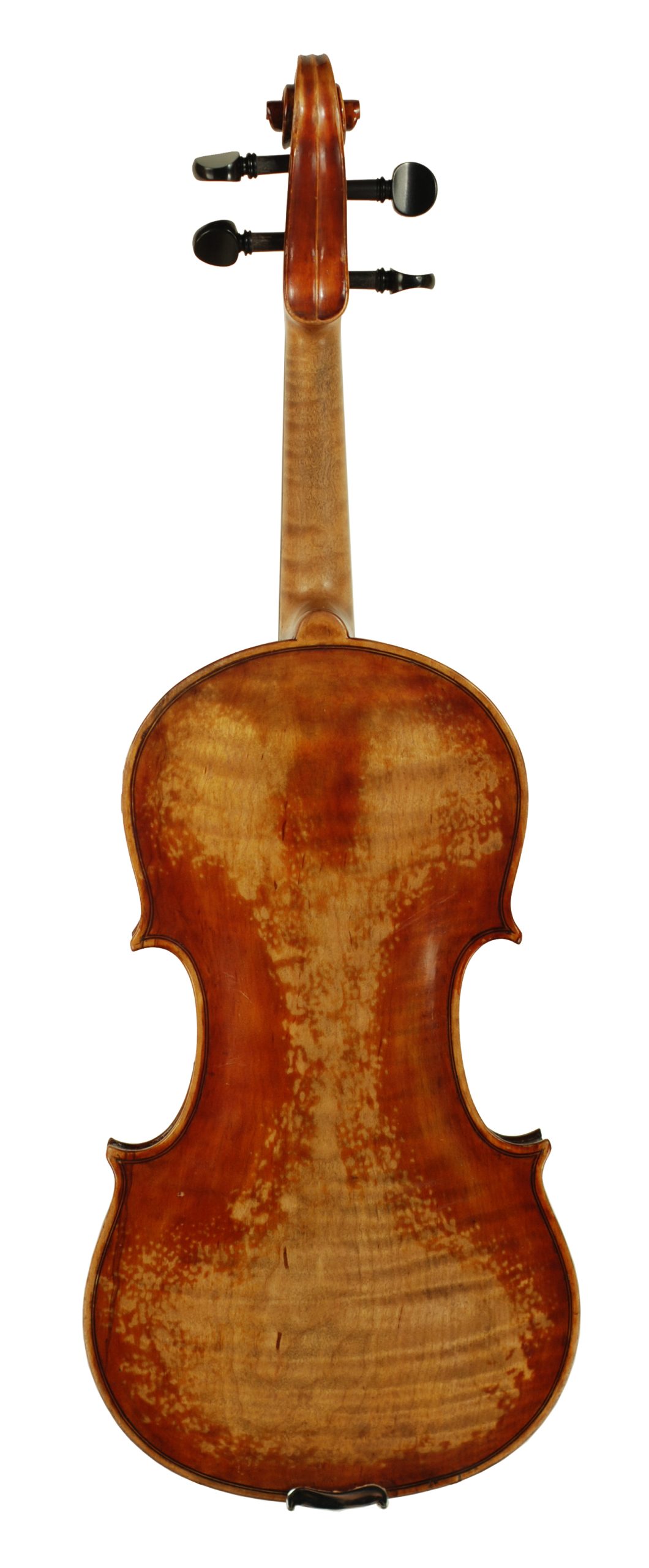
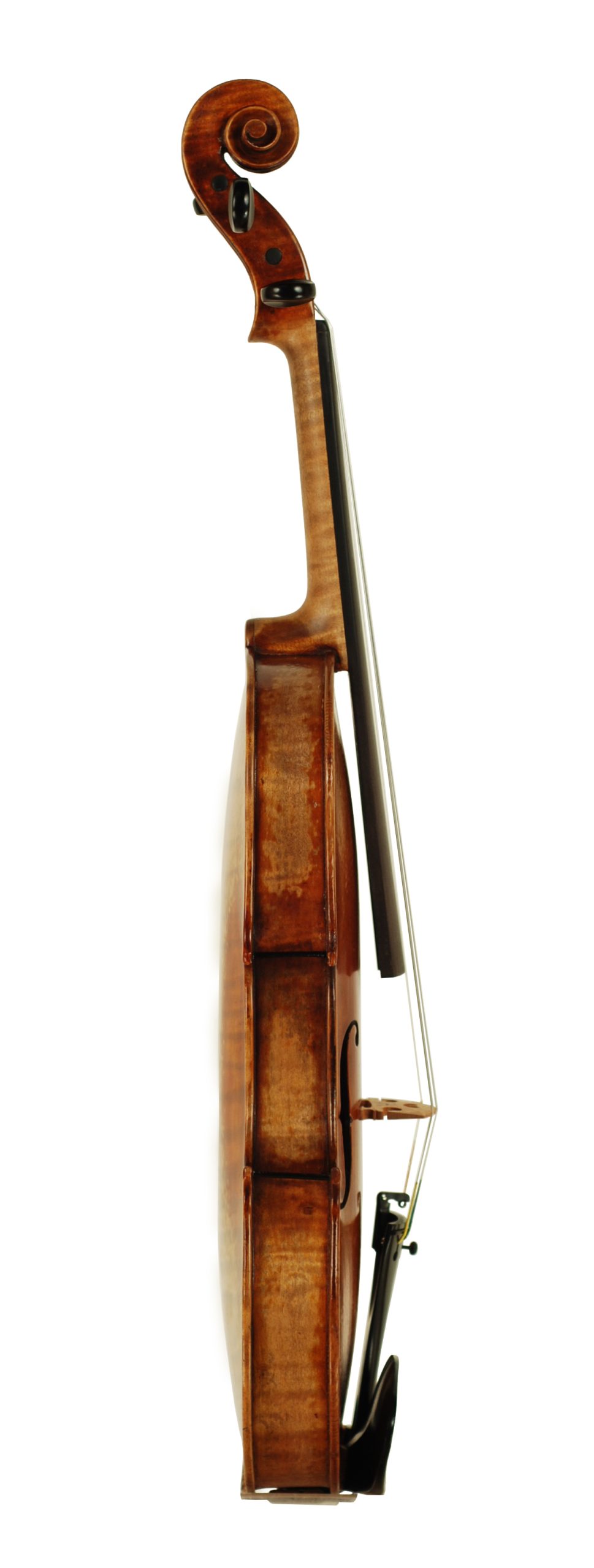
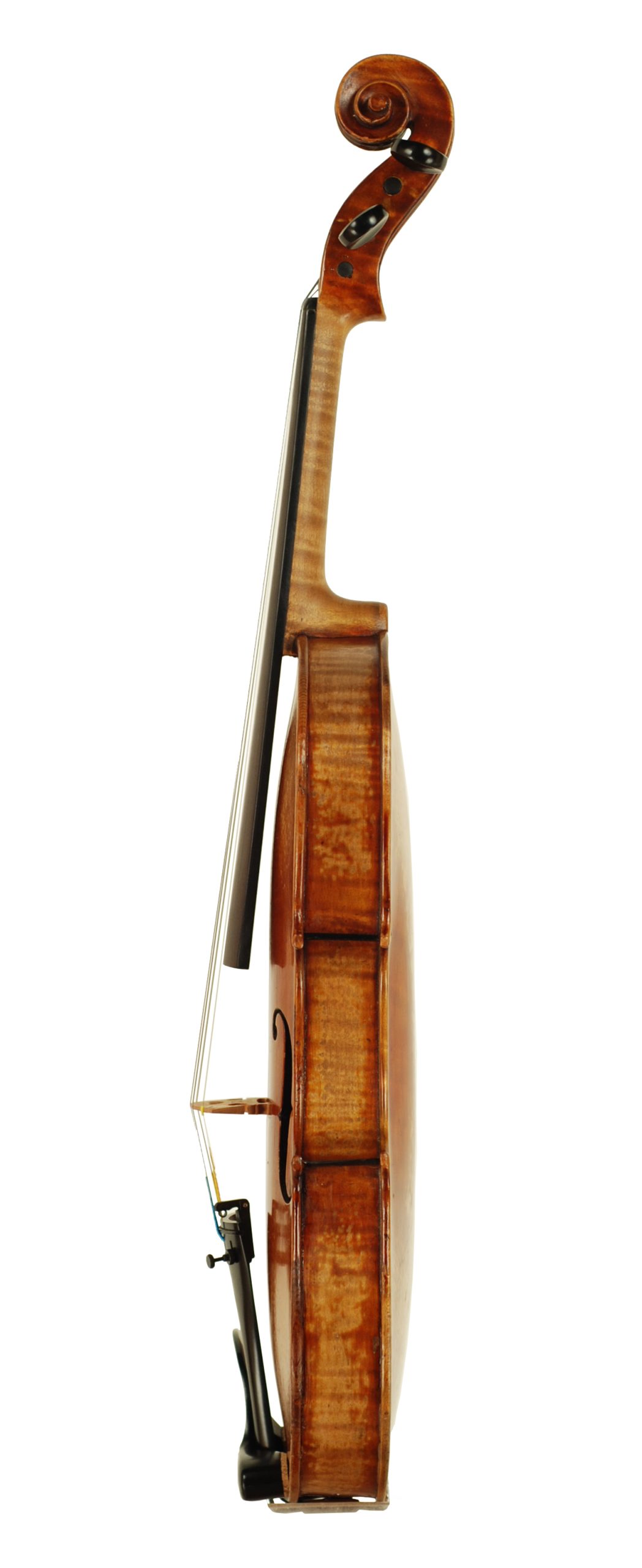
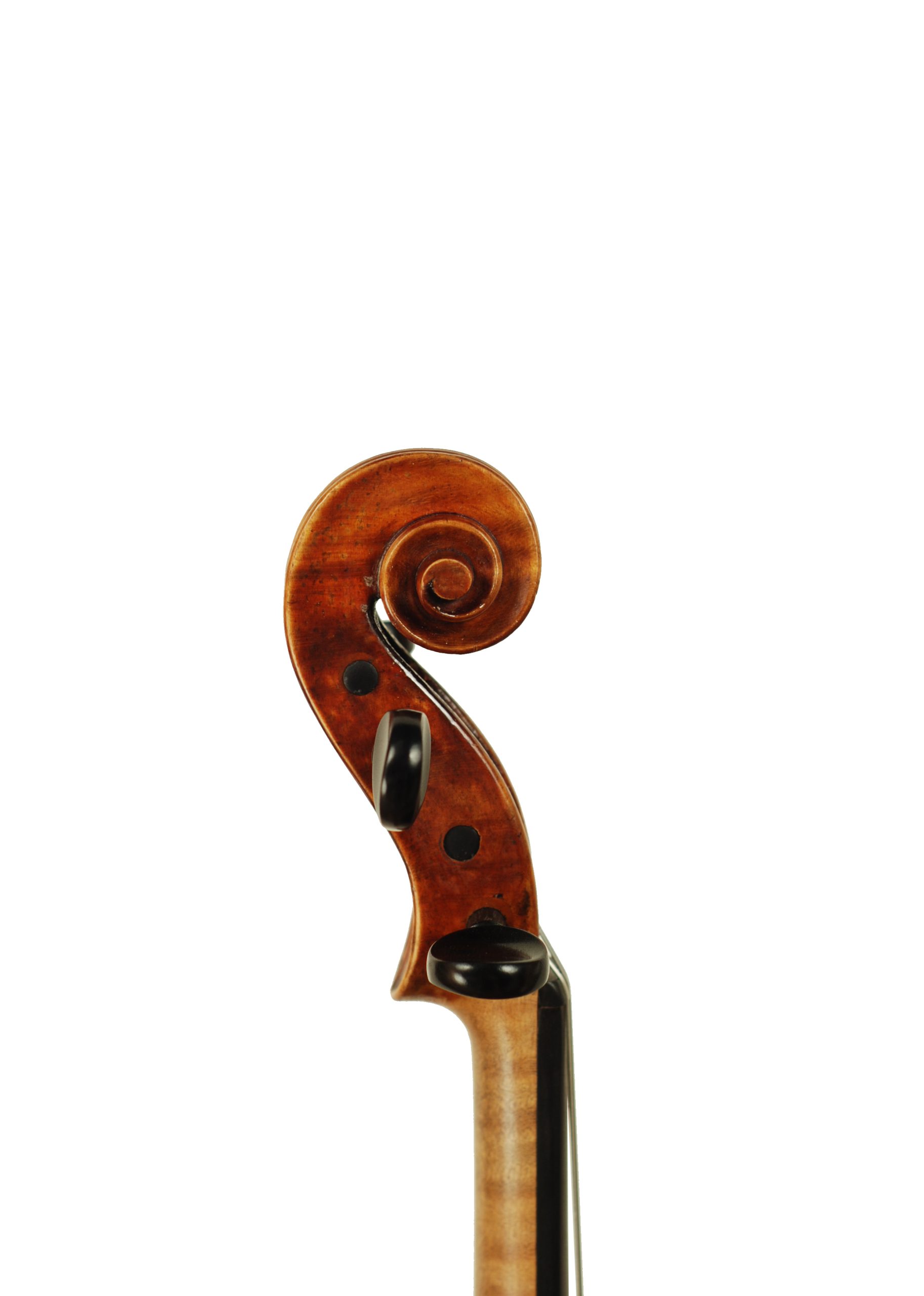
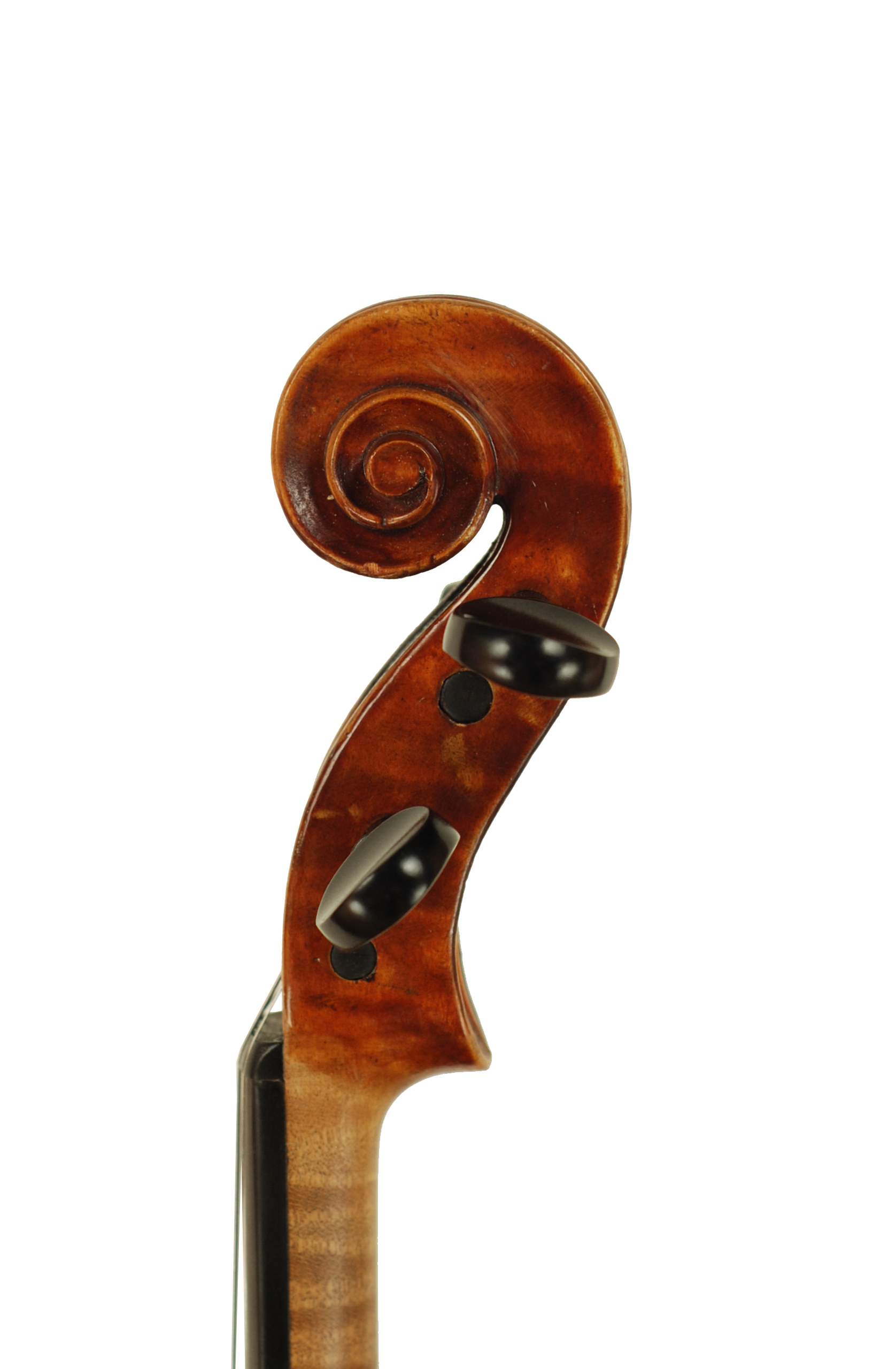
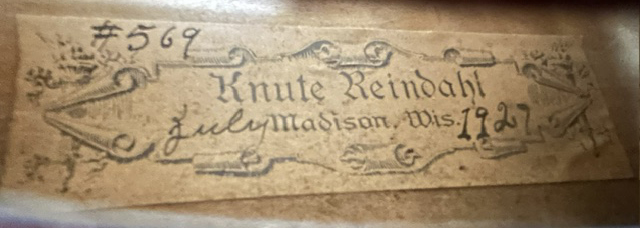
Fine Violin Made by Knute Reindahl No. 569 Madison, Wisconsin July 1927 – Awesome Violin!
$10,500.00
click picture to enlarge
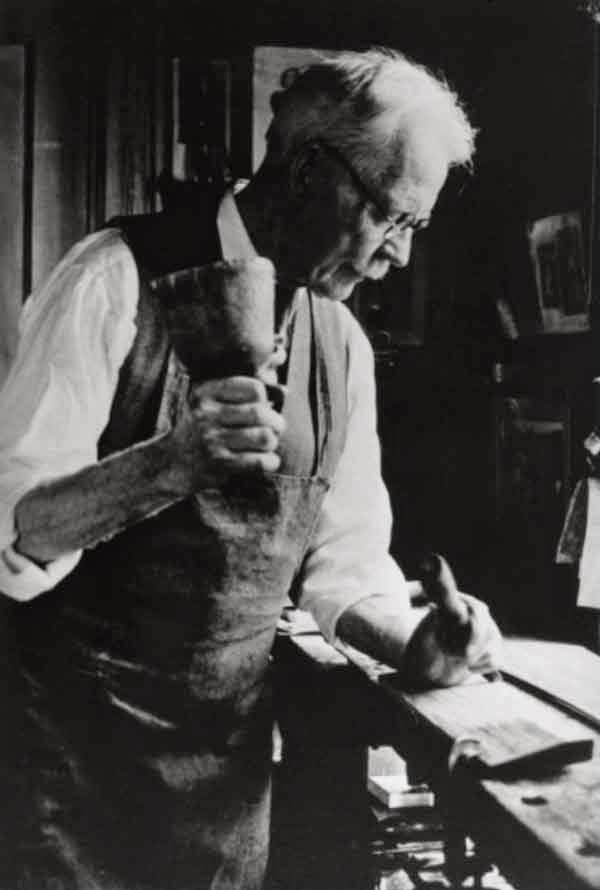
Knute Reindahl 1857-1936 was born November 16, 1857, in Telemark, Norway where fiddle making had long been a tradition in his mother’s family. Beginning with Knute’s great-grandfather, Olav Gullbekk circa 1760-1836, several generations had produced makers of both Norwegian Hardanger fiddles and classic Italian instruments. Knute’s widowed mother emigrated to America with her seven children in 1869 when Knute was eleven years old, settling near Madison in the Town of Burke, Wisconsin. Knute had little schooling, never making it past 5th grade. He’d rather carve salad bowls and picture frames than study books. Selling his handmade trinkets, he visited Indian camps on Lake Monona by the city. before coming to America, Knute realized wood carving was his only interest. The neighboring Ho Chunk Indian tribe in Madison also taught him how to make bows and arrows. He peddled these and other carved items such as spoons and letter openers door-to-door and to local stores to help his family.
Working as a hired man on farms and construction sites as a young man, Reindahl saved enough money to return to Telemark in 1887, and attended a Sloyd school to learn ornamental woodcarving, studying woodcarving and distinguishing himself as an ornamental carver. He had learned the best violin makers like Stradivarious and Amati had originally been wood carvers. Two years later he was back in America, but success did not come quickly. I think it was Reindahl’s fierce determination to become very good at something that brought him great rewards. He learned and studied violin making and the violin trade with Peter C. Paulsen in Chicago between 1889- 1900. When the Chicago Symphony Orchestra moved into a newly built Orchestra Hall on Michigan Avenue, the old violins built by masters were too weak to be heard. The director of the orchestra bought five of Reindahl’s violins to replace the other violins. In 1900 one of Reindahl’s violins won the Diploma of Merit for woodcarving and received a special medal for it at the World’s Fair in Paris. Reindahl was the only violin maker mentioned in the “Who’s Who” of the World Columbian Exposition in Chicago in 1893. When Fritz Kreisler was honored in Madison, Wisconsin he was presented with a Reindahl violin. His handwork on the instruments is impeccable and his carving skills, gifts I’m sure the Lord gave him, improved with each instrument he made.
In 1889 Knute went to Chicago, where he worked as an ornamental woodcarver, first for the Pullman Car Company. I have witnessed firsthand the quality of the carving interior of one of these Pullman railroad cars at “Hildene” Robert Todd Lincoln’s “summer cottage” family home in Manchester, Vermont. The woodworking workmanship on these cars is off-the-charts beautiful. Knute later became the foreman of the woodcarving shop of the Windsor Folding Bed Company.
Knute really got serious making handmade violins in the early 1890’s and in 1899 he established a studio in the Atheneum Building at the corner of Wabash Ave. and E. Van Buren Street. Without assistants, Reindahl produced 585 violins and some 20 each of violas and cellos. He also made an unknown number of bows, at least one guitar, and one pitchfork cello, or “Viking Cello” as he called it. Several of his early instruments exhibit his fine carving and engraving. He made instruments of the violin family in his Chicago atelier until the Summer of 1915, when he moved his family and business back to Madison, Wisconsin. Knute continued making and repairing instruments at his studio in Madison until sometime in 1935 when he became disabled by illness. He died in Madison on January 17, 1936.
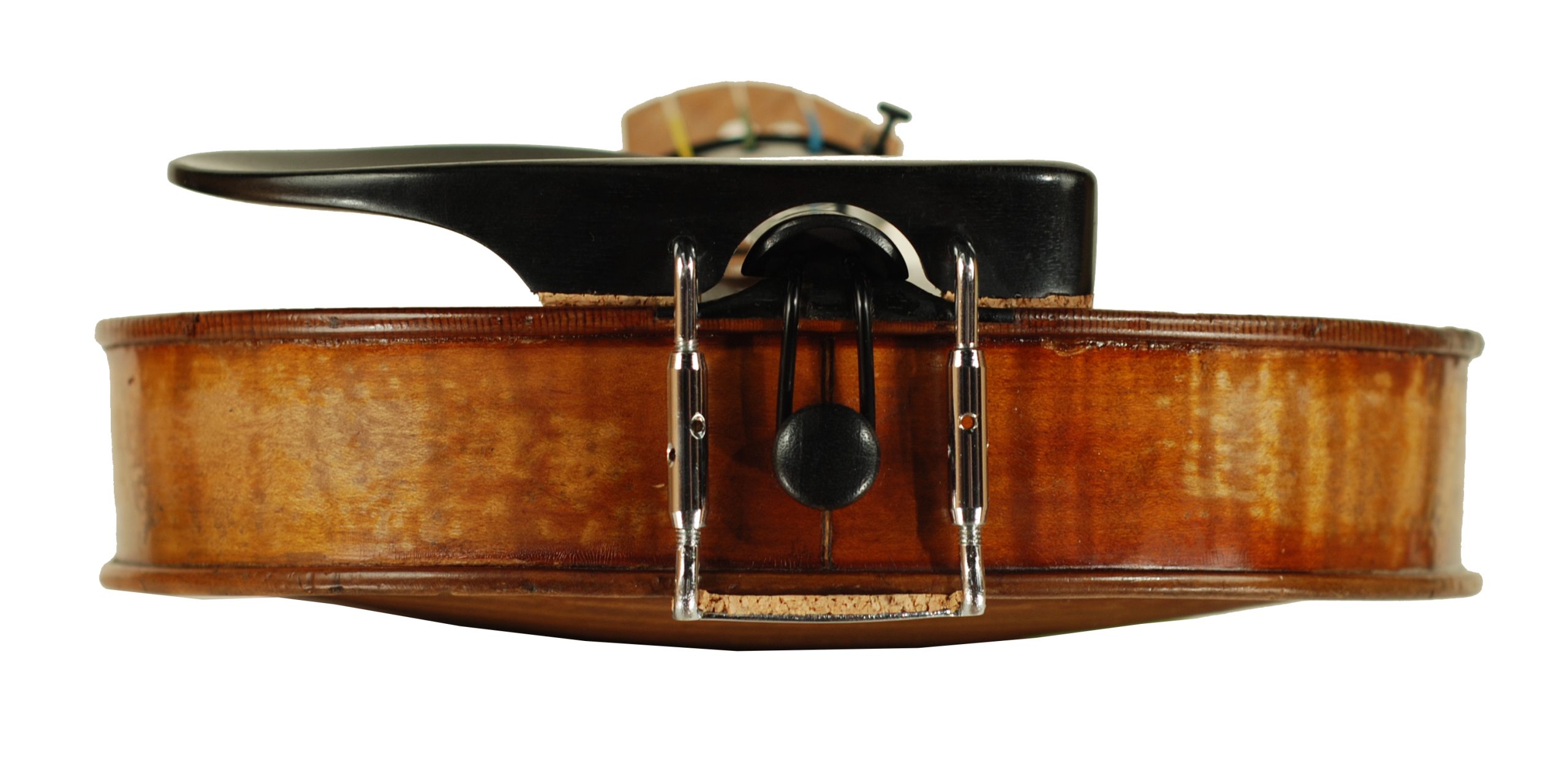
Our violin is number 569 and was well played. Yes, this violin was complted in July of 1927. The violin was first purchased by Ms. Pearl Hinkel of Chicago, who likely had known of Knute Reindahl during her younger years learning the violin. Ms. Hinkel moved to Madison in 1929, and was employed as a music techer at the Wisconsin School of Music for many years until her retirment. She was also the founding member of the Madison Symphony Orchestra. Ms. Hinkel lived only a few blocks from the Reindahl residence and workshop in Madison, and was Reindahl’s “go to” person to play and evaluate each of his newly made instruments. Following her death this violin was in the possession of her daughter, Peg Stiles of Monona, WI and subsequesntly to Peg’s daughter, Cynthia Stlies, also of Monona, WI. The violin was purchase from Ms. Stiles three years ago by Douglas Anderson of Madison whom I purchased it from. We meticulously went over the violin, bushing all eight holes and cut a new set of ebony pegs, a new fingerboard and nut. We gave the violin a new soundpost and bridge, tailpiece and chin rest. In short, an entire new set up. The violin has no issues and has a beautiful one-piece back. The varnish is a deep orange/brown on an amber base.
Much of this detail information about Knute Reindahl has come from a gentleman, Ron Humphrey who grew up two houses away from the Reindahl home in Wisonsin. Ron called, spoke to me here at our shop once he learned about the Reindalh violin we have. Ron grew up playing with Knute Reindahl’s grandchildren! Another Wow! So many thanks to Ron and his help with all the details about this violin and about Knute’s life.
Corpus 357.0 mm. Major Width 206.0 mm. Minor Width 167.5 mm. Rib height 30.0 mm
The sound literally jumps off the strings. Yes, the response is quick. The tone is deep and rich and the strength of this instrument was noticeable as soon as I played. The bottom end has a gutsy quality, rich, ringing, and woody. The overtones are evident and assist in the sustain of the instrument. The response off the G is powerful and each of the other strings exhibit the same drive and sustain. The E and the A are vibrant and noticeably clear. The violin has a great overall sound; tonally inviting and better than the best cup of coffee you have had this summer. It is a beautiful violin full of history, and it is not a wonder the director of the Chicago Symphony purchased 5 of his violins the first year he was open for business.
Related products
-
Johann Christian Schlosser Violin
$8,000.00 Add to cart