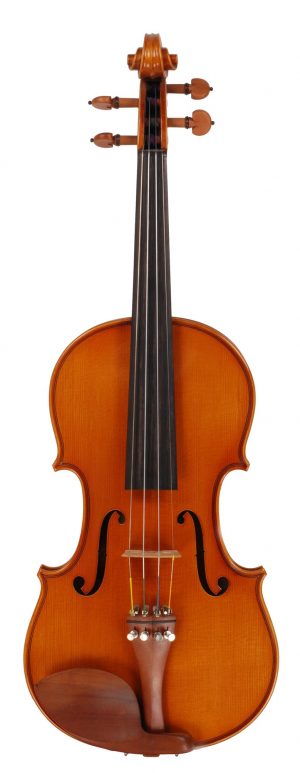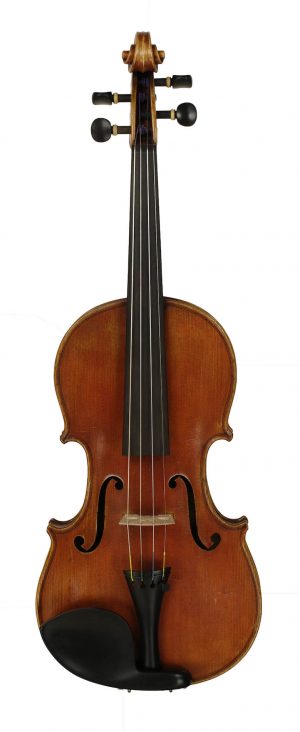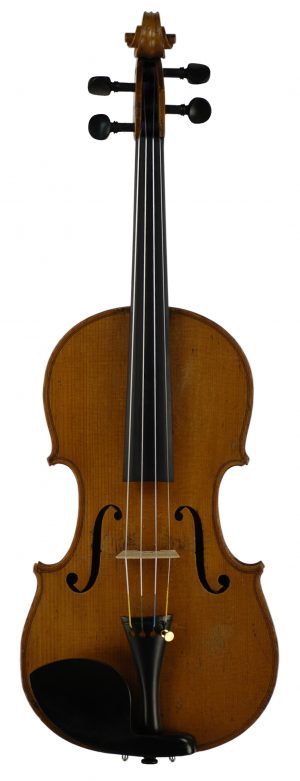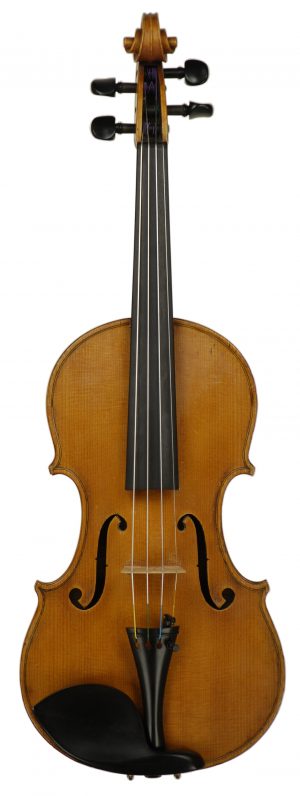
Nach Stainer Violin Made By C. F. Schuster & Sohn – Markneukirchen/Saxony circa 1910-1920
$2,795.00
click picture to enlarge
Label:
Erzeugt von
C. F. Schuster & Sohn
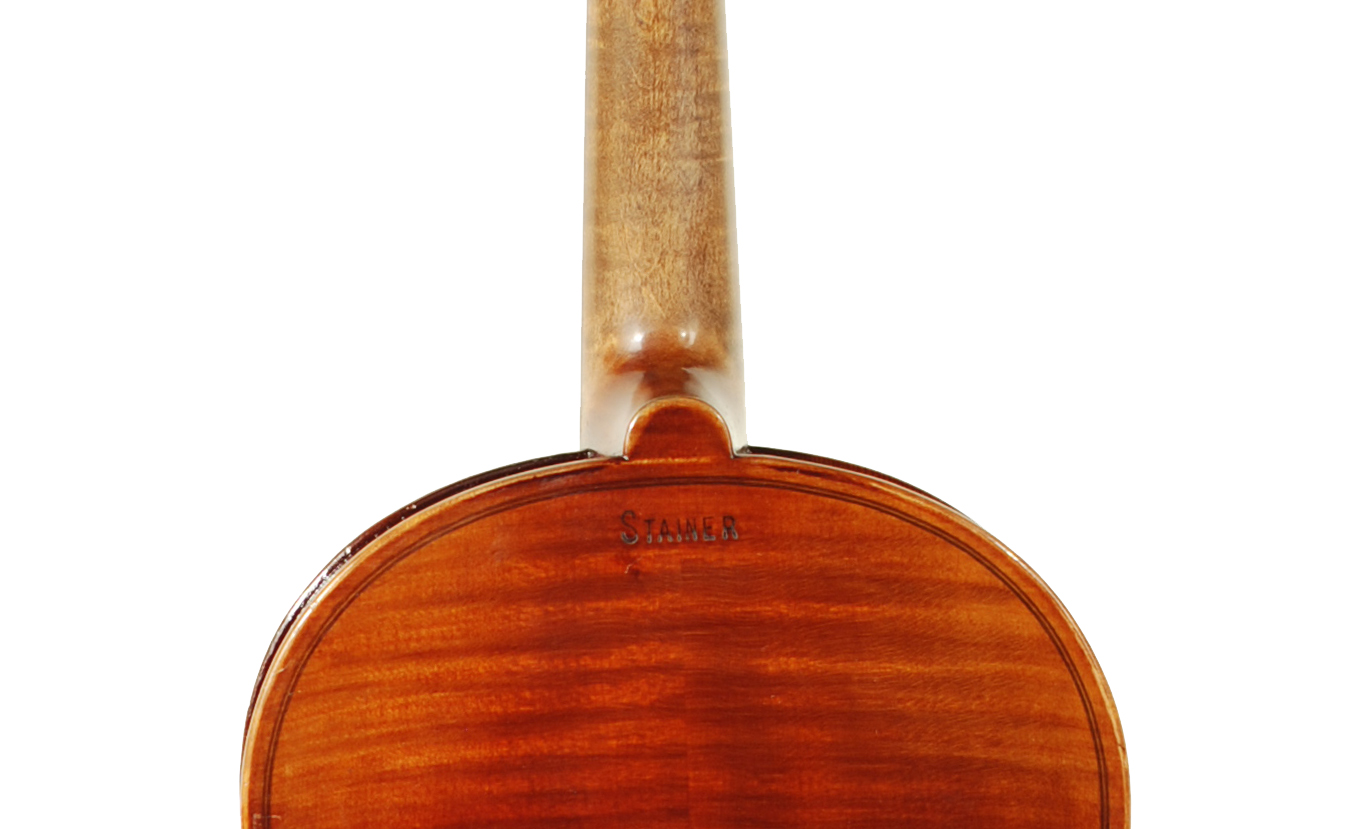
Stamp:
Nach in German means “after.” Jacob Stainer was born in 1617 and died in 1683 in Innsbruck Austria. He was an influential maker whose fame lasted well into the 18th century. His modeling was copied extensively throughout Europe. The entire Tyrolean German school of violin making and the area in and around Markneukirchen, Klingenthal, and Schönbach was based on replicas of his work. The Stainer model also became dominant throughout Italy, France, and the Netherlands. Only in the 19th and 20th centuries did Stradivari’s work have an appreciable effect on this tradition. The beginnings of Stainer’s career are very difficult to uncover. He was a son of a salt miner, apprenticed between 1630-1644 to Daniel Hertz, an organ builder in Innsbruck, and to a joiner, Hans Grafinger, in the village of Absam, Innsbrook, Austria. Stainer may have traveled widely in his early life from Salzburg to Venice and Rome and that he possibly worked for a time with Nicolo Amati in Cremona. In 1644 Stainer made and presented an instrument to the Salzburg court orchestra. He became an appointed luthier to Ferdinand Charles, Archduke of Austria in 1658 and in 1669 was made an “Imperial Servant” to Leopold I. In that same year Stainer was arrested as a suspected Lutheran. By any standards he was an exceptional man. He was the only maker to be held in equal terms with the famous Cremonese makers because of his craftsmanship and attention to detail. Our violin is a replica of a Stainer model and made as the label states “After” Nach by the C. F. Schuster & Sohn violin making firm. This violin making company made a significant number of instruments from 1850-1920. The firm was based out of Markneukirchen in the State of Saxony and produced and exported higher end trade instruments.
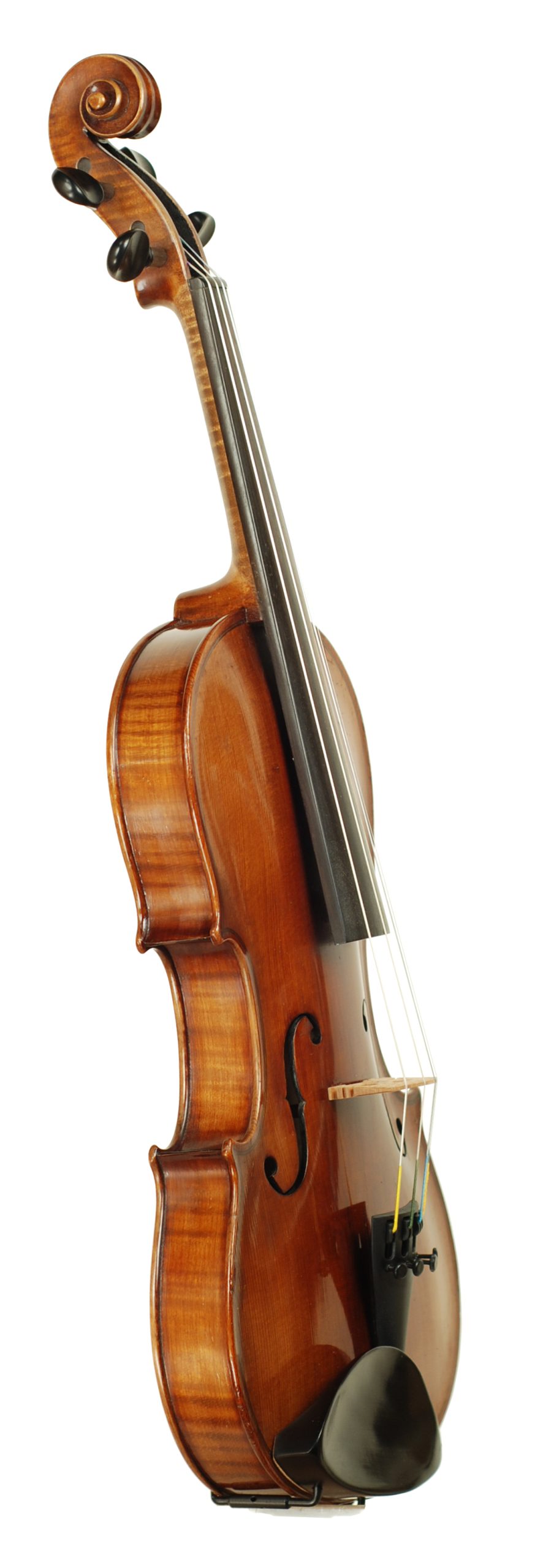
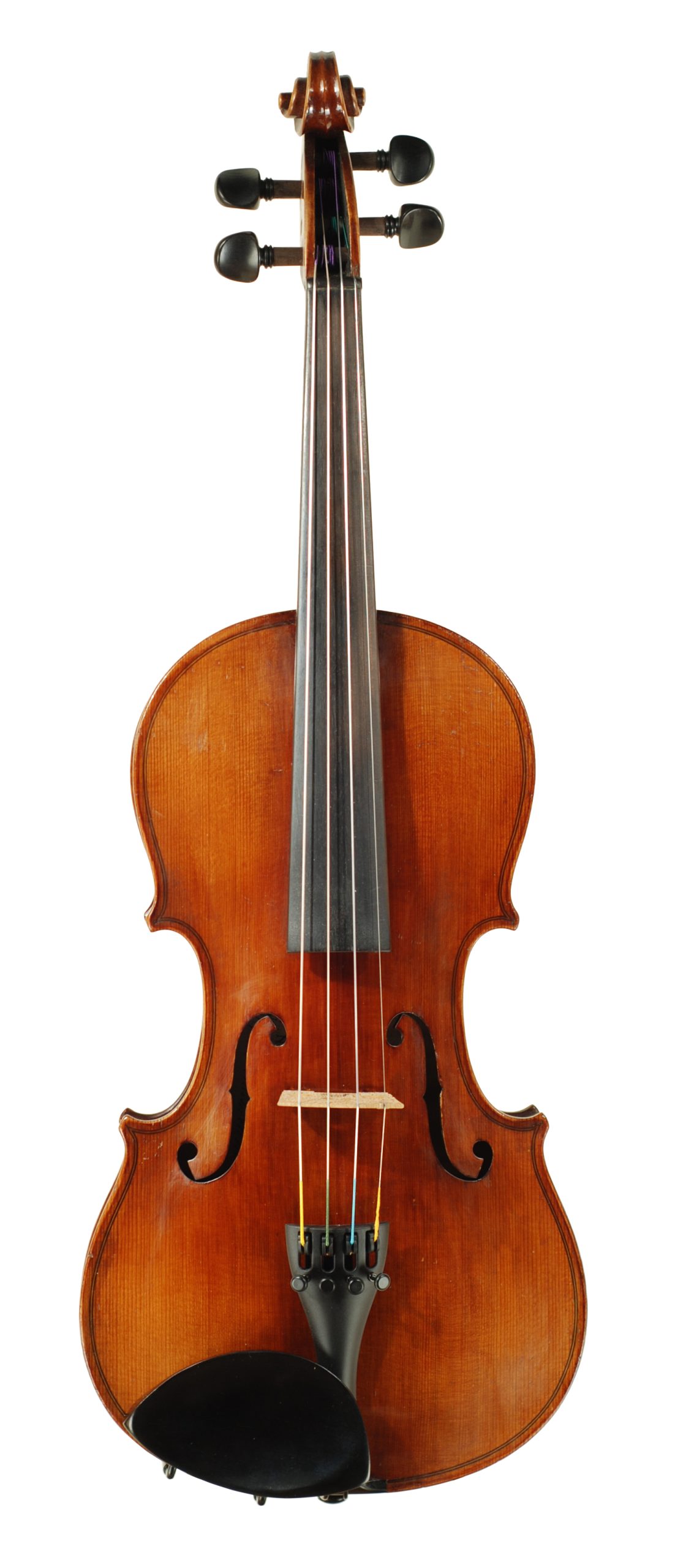
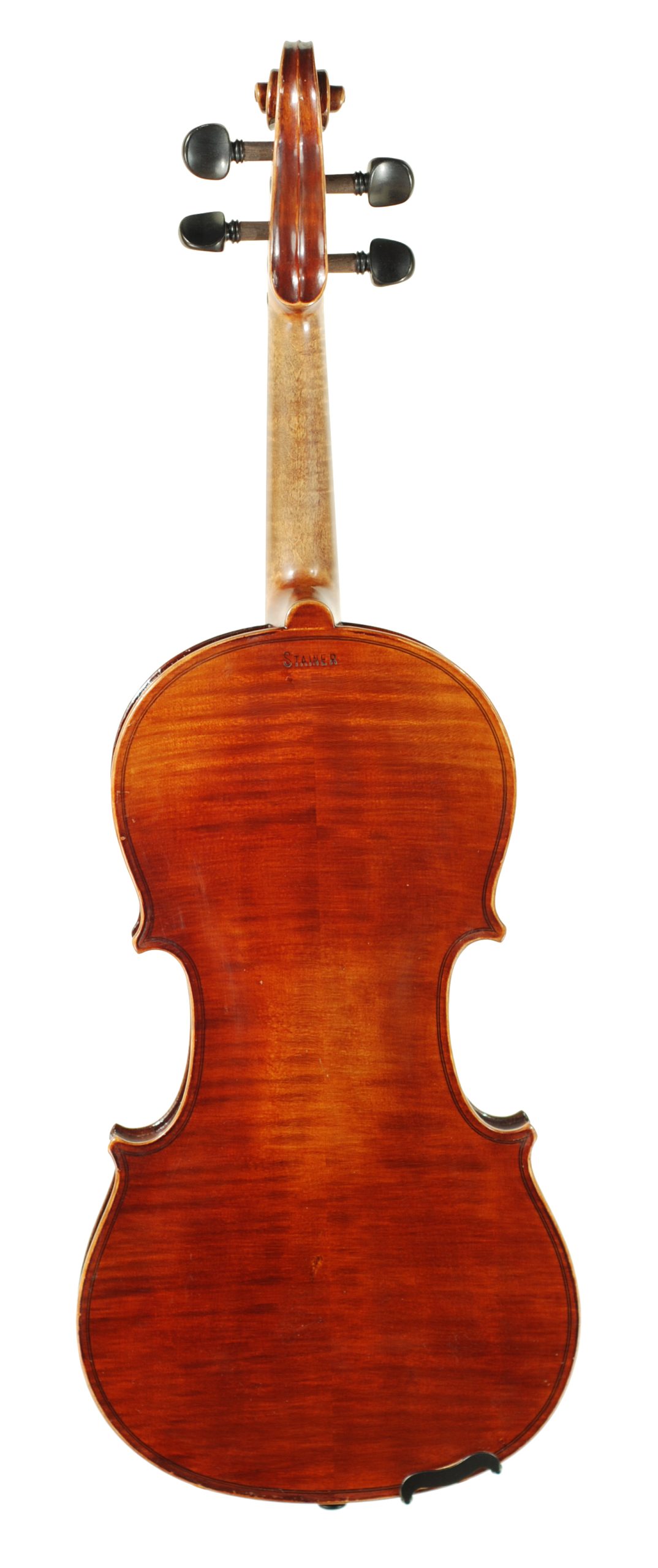
Our violin has Amati style f holes with a large overdone diapason and the arching in the plates are at a medium height. The violin is slightly long in the corpus, and the spruce table has a medium to fine grain which widens towards the flank on the bass side. The back of the violin is made of attractive maple with matching ribs. We have completely gone over the entire violin giving the instrument a new fingerboard, set of ebony pegs, bridge, soundpost, tailpiece, chin rest, and end button. The violin is in very good condition with an oil varnish that is amber/brown on a yellow ground.
Corpus 359.0 mm., Major Width 206.0 mm., Minor Width 166.0 mm., Rib Height 29.0 mm.
The sound of the violin is a bold and has a focused response off the strings. I tried two different strings sets. Thomastik Vision – regular vision and our standard set up Thomastik Dominants with the silver D and Pirastro WonderTone Gold Label E. I felt Visions gave even more power to the violin, awesome if you’re possibly just looking for strong focused sound. The Dominant mix sweetened up the over sound for my taste. I left the Dominant set up on but you could go either way. It’s not like a modern powerhouse soloist violin but still has strength. The sound is full and responds quickly. The G and D strings ring with a covered presence. A strong sound leaning in tonally to the darker side of sound. The E string is full-on power. It’s brighter than the A string and does not hold back. The A string is like support staff, a yes in brightness but not as much. I discovered after playing for a while that the sound is clear with a fair amount of power throughout the voices. The violin surprised me. The response from the body was great, maybe not as refined as a 10 K violin, but still very nice. The violin can handle quick articulations with a strong right arm and can easily give you various dynamics and give you (ff) when called on. The instrument has vocal strength and is looking for a player that can tame the response.