A Fine Violin by Matthais Klotz – Mittenwald Dated 1708

$20,000.00


click picture to enlarge

Label:

Mathias Kloz Lautenmacher
In Mittenvvaldt, Anno 1708

The Klotz family of violin makers, about twenty-five of them, made instruments from the mid-1600’s to 1970. They made their instruments in Mittenwald, Germany. Matthias I was born in 1656 and died at age 90 August 16, 1743, in Mittenwald. His father, Urban Klotz (1627-1691) was a tailor and his mother was Sophia, who died in 1681. In documents in the town Matthias was repeatedly described as a world-renowned lute and violin maker. Klotz got interested in music and instruments in his early childhood. From 1672-1678 he apprenticed with lute maker Giovanni Railich, an Italian lute maker at Bottega di Lautaro al Santo in Padua, Italy. There is a surviving journeyman’s certificate in Padua that confirms his initial apprenticeship work. That is a Wow! It is not certain how Matthias got into his own style of violin making, but he started out making lutes. He might have spent some time with another violin maker or two in Italy, but nothing is certain. But by 1683 he returned to Mittenwald and became established as a lautenmacher (lute maker) in Gries, a part of Mittenwald. He later moved his workshop to Oberen Markt and then to the Herrengasse area in the town.

Matthais has three sons from two marriages who became violin makers: Georg I, Sebastian I, and Johan Carl, who all stayed in Mittenwald. Matthias also employed and taught others the craft at various times in his life, which is awesome to see. Among his students were Andreas and Johannes Jais, Martin Dieffenbrunner (Tieffenbrunner), Johannes Daenzl (pronounced Tentzel), Woernle, Schaendl, and Martin Baader. His workshop in Mittenwald brought him excellent business opportunities right from the outset. Not just because of his carving skill level but also three other major reasons: first the wood of the Karwendel mountains ensured a rich supply of choice tonewoods, second, Mittenwald’s location along an important trans-Alpine trade route offered him advantages as a merchant and third, at his time in history Matthais Klotz had almost no local competition. Matthais did not build most of his violins in the classical Italian style, but made them similar to the masters from Füssen, a small village in Bavaria and Swabia, a southern region in Germany. Many elements of his modeling reflect the style of Tyrolean maker Jacob Stainer.

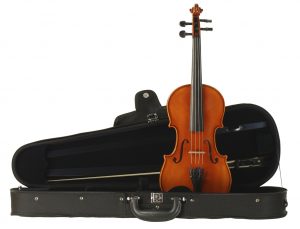
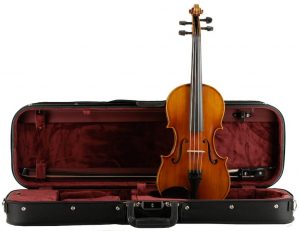
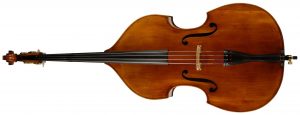
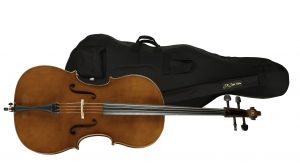
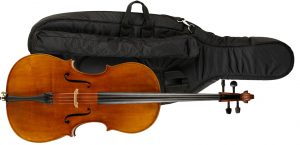
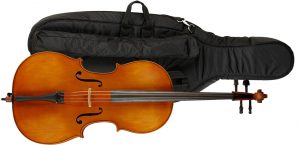
This Stainer modeling is more German in style, with a higher arch in the plates, deep narrow edge fluting, and very curved sound holes. Our violin follows in this Füssen and Stainer modeling. We have meticulously gone over the violin here in the workshop. Bushed all eight peg holes and cut a new set of ebony pegs with pear wood pins and collars. We gave the violin new fingerboard and new nut, cut a new Despiau grade B bridge, and cut a new soundpost. I found an older 19th century ebony tail piece for the instrument and completed the fittings with a Guarneri chin rest and ebony end button. The violin has a moderately flamed two-piece maple back with maple ribs that match the degree of the back flame. The spruce top has a very fine grain, choice wood, and the amber/brown varnish color is full of character and the patina that comes from natural wear. The instrument has no issues and is very healthy.

Corpus 352.0 mm. Major Width 203.0 mm. Minor Width 165.0 mm. Rib Height 29.0 mm.

Matthias had a talent for woodworking and making instruments. There is a bronze statue of him holding a violin in front of the church of St. Peter and Paul in Mittenwald in 1890. His craft helped shape the town of Mittenwald. He had a knack for creating and delivering sound from instruments which never had any electrical tools to assist in its completion. Tree to performer, maybe 15 years to dry the wood and 200 hours to build. This is a beautiful violin to play. The sound is on the darker side, not bright. It has guts where you want it and maturity in its tone, along with a warmth all wrapped up in a very responsive violin. The tone off the strings sustains the sound and the sound is smooth. The violin responds with just the slightest touch from the bow. This responsiveness off the strings simply makes me notice the violin. The high register is exceptional, and the entire range of the instrument has tonal strength and character. The overtones are warm and full of color. Even a lighter violin bow brought out depths of color you don’t find in a new instrument. If you’re looking for an older quality instrument, this is it. The engaging sound will bring a smile to your face as soon as you have it in your hands for one minute.